
“The Questions” in the Vigyan Bhairava Tantra, establish the fundamental premise of the entire text: a divine dialogue driven by love and a profound thirst for truth. This section is not a dry theological discussion but a deeply intimate exchange between Lord Shiva (God) and his consort, Parvati (the Goddess), setting the stage for the revelation of the 112 meditation techniques for enlightenment.
The Foundation of Love and Oneness
The very first and most essential point is that the Vigyan Bhairava Tantra is a story of love—a dialogue between two beings “deeply in love.” This emphasis on love is paramount, serving to convey three major truths. Firstly, it is through unconditional love that one can truly understand and know God, echoing the sentiment from the Bhagavad Gita: “Only by love can men see me, and know me, and come unto me.”
Secondly, the relationship between a master and a disciple is highlighted, with the Goddess taking on the role of the disciple for the benefit of humanity. For the disciple (Parvati) to receive the master’s (Shiva’s) knowledge, she must first “empty her cup” of preconceived knowledge, a process enabled by the trust and faith that comes with love.
Finally, love is crucial because it automatically transcends dualism, leading to a sense of oneness. In deep love, the sense of individual identity dissolves, making it an essential precursor to reaching God, which requires transcending one’s individual ego.
Parvati’s Doubts: Questioning the Nature of Reality
The Goddess begins by stating that, despite having heard everything originating from the “union of God and the Goddess” and the essence of the Trika System (Kashmir Shaivism, a non-dual philosophy), her doubts remain. Her questions are essentially the seeker’s deepest inquiries into the nature of the Supreme Being:
-
What is your real nature? Is it merely a collection of words (referencing the Kashmir Shaivism Theory of the Alphabet)?
-
Does your nature consist of nine different forms, a combination of three different heads (Trishiro Bhairava Tantra), or three energies (Supreme, Medium, and Inferior)?
-
Are you consisting of sound, or point, or half moon (references to specific meditation techniques/energetic forms)? Is your nature that of energy ascending the chakras, or is it the voweless sound?
-
Is medium and inferior energy divisible in parts? If so, how can the supreme energy be transcendent and indivisible?
These last two questions, especially, cut to the core of the non-dualistic philosophy. If individual life forms (inferior energy) appear separate and divisible, how can they simultaneously be part of God (Supreme Energy), who is indivisible and whole? The Goddess essentially presents the argument of dualistic traditions.
Shiva’s Answer: The Illusion of Divided Forms
Lord Shiva’s response is immediate and definitive, validating Parvati’s questioning by calling it the “essence of tantra.” He proceeds to address her doubts in two main ways: by negating what God is not, and then by revealing what God is.
The Negation (What God is Not):
-
Shiva refutes the concepts raised by Parvati—the nine forms, words, three heads, three energies, sound, point, or half moon.
-
He declares that these concepts are merely supports for “people of confused minds” who are “stuck in dualizing thoughts” and prefer external actions and rituals. They are necessary only to help those whose intellect is not yet mature enough to grasp Ultimate Reality, serving like a mother who frightens children away from danger to start their spiritual practice.
-
Shiva unequivocally states: “I am free of all concepts of time or direction. I am not at a particular place. It is impossible to accurately represent or describe God in words“. God is beyond mind-based limitations and descriptions, requiring direct experience, not intellectual understanding.
The Revelation (What God Is):
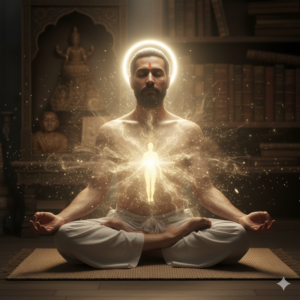
The positive explanation of God’s nature is revealed as: “One may experience the joy of God within oneself, when the mind is still and free of thoughts. That state of God full of bliss, is the Goddess.”
-
God’s nature is Joy: Lasting happiness is found only within, not in the external, changing world.
-
The Key is the Still Mind: Stilling the mind dissolves the ego, allowing the True Self (which is God) to appear. This is “liberation.”
-
The Goddess is Bliss: The state of God, “full of bliss,” is identified with the Goddess, reinforcing the ultimate non-dual truth that the God (Shiva) and the Goddess (Shakti/Bliss) are one.
“One should know my essential nature to be that joy, pure, and pervading the entire universe.” It questions the purpose of ritualistic worship (“who is to be worshipped and who is to be satisfied?”) when God is everywhere and needs nothing.
Energy, Illusion, and the Ultimate Question
Shiva then addresses the paradox of duality by asserting that the separation seen in the world is an illusion (māyā):
-
Divided forms are “insubstantial,” like a magic show or a dream. The world is God’s play (līlā), a necessary “contrasting field” that allows the Ultimate Reality to experience its own nature (joy) against its opposite (pain), preventing all experience from becoming a void (shunya).
-
God and Goddess are One: Shiva explains that the differentiation of God and Energy (Goddess/Shakti) is made only to help one understand the different aspects of the One Supreme Reality, which is neither male nor female. There is “No difference ever exists between energy and the possessor of energy”, just as the burning power is inseparable from the fire.
The dialogue culminates in the Goddess’s final plea: “By what means can one acquire and be filled with that form of God? In what way is the Supreme Goddess, the entrance to God? O God, explain it to me in such a manner, that I may understand it fully.”
Shiva’s ultimate answer to the “how” is not a philosophical expansion but a practical instruction: the 112 meditation techniques. The text emphasizes that words are inadequate to explain Ultimate Reality; only experience can lead to full understanding. This immediate shift from profound questions to practical methods underscores the core teaching of the Vigyan Bhairava Tantra: start the spiritual quest and experience God directly, rather than waiting for all intellectual answers.