
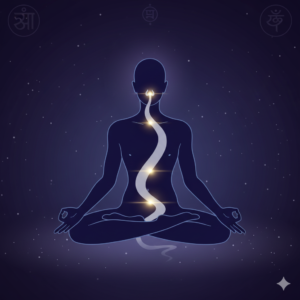
This second meditation technique as mentioned in the Vigyan Bhairav Tantra text is presented as a slight variation of the first, designed to lead the practitioner to the realization of God through a broadened awareness of the breath’s transition points.
The Expanded Focus: Inside to Outside, Outside to Inside
Lord Shiva’s instruction refines the area of concentration:
Concentrate on the two places where the breath turns from inside to outside and also from outside to inside. O Goddess, in this way, through the Goddess, the essential form of God is realized. (Verse 25)
The key difference from the previous verse is the expansion of the focus. Instead of concentrating strictly on the pinpoint origin of the breath (the pause), this technique directs attention to the turning of the breath. This larger area encompasses:
-
Inside to outside: The point where the inbreath ends, the small gap or pause, and the outbreath begins.
-
Outside to inside: The point where the outbreath ends, the second gap, and the inbreath starts.
The complete breathing cycle has two such turning points where the breath reverses direction. By focusing on this transition zone, the mind is anchored in the present and experiences the stillness inherent in the shift of energy.
Practice Instructions
Like the previous one, this is a sitting meditation practiced with eyes closed.
-
Observe the transition: The focus is on the area where the inward breath “is ending” and the outward breath “is starting,” and vice versa.
-
Maintain continuous awareness: The practitioner must be continuously aware of the full breathing cycle, with heightened focus on the turning points.
-
Mind’s Attraction to Rhythm: The commentary explains the effectiveness of breath-based techniques: the breath is the “most natural rhythm found in life,” to which the mind is easily attracted.
-
Anchored in the Present: This meditation, by directing attention to the immediate, continuous rhythm of the breath, “bring[s] the mind to the present,” allowing the mind to “automatically dissolve” when focused long enough.
The Path of Energy (Goddess) to God
The result promised is the realization of the “essential form of God,” achieved “through the Goddess.” The Goddess represents the breath/Energy, and by concentrating on this energy in its most subtle turning, the practitioner reaches God. It is a process of transcending the thinking mind, which is the ego-self, and becoming pure awareness.
If the mind is distracted by thoughts, the instruction is clear: simply bring the mind back to the practice, without dwelling on the thought or feeling upset. Gradually, the thoughts will diminish and be “eliminated altogether”.