
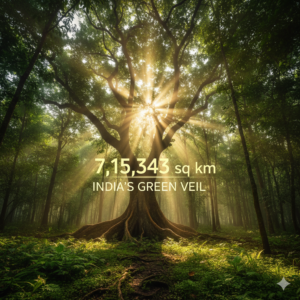
A quiet revolution is unfolding across the vast expanse of India, a tale of growth whispered only by the wind through the leaves. Far from the clamour of cities, the country’s colossal green heart continues to beat, meticulously measured, catalogued, and guarded by the silent sentinels of the Forest Survey of India (FSI). This is the story of India’s forest cover—a mysterious resource, constantly shifting, and vital to the destiny of a billion lives.
I. The Great Green Census: Unveiling the Numbers
The Forest Survey of India, through its biennial India State of Forest Report (ISFR), acts as the chief cartographer of this hidden kingdom. Its latest assessment pulls back the curtain on the nation’s ecological treasury, revealing a landscape that is both striving and struggling.
| Metric | ISFR 2023 Data | The National Goal (1988 Policy) |
| Total Forest Cover | 7,15,343 sq km | N/A (Focus is on combined cover) |
| Forest Cover Percentage | 21.76% of Geographical Area | N/A |
| Total Forest & Tree Cover | 8,27,357 sq km | 33% of Geographical Area |
| Combined Cover Percentage | 25.17% of Geographical Area | 33% |
The Whispered Growth
The latest data shows a modest, yet significant, forward step. The nation’s total forest and tree cover has increased by 1,445 sq km since the previous assessment. This growth is a testament to the quiet efforts in areas outside traditional forest boundaries—the trees lining highways, dotting farmlands, and guarding urban edges.
II. The Guardians of the Deep Forest
Where does India’s green soul reside most strongly? The FSI’s maps reveal the true green guardians of the subcontinent:
-
Area King: The state with the largest forest cover by absolute area is Madhya Pradesh (77,073 sq km), home to some of India’s most iconic wildlife.
-
Percentage Champion: In terms of density, the island territory of Lakshadweep (91.33%) and the state of Mizoram (85.34%) lead the way, embodying the National Forest Policy’s ideal where vast majority of the land is blanketed in green.
-
The Challenged East: While states in the Northeast remain among the greenest, the report notes a concerning trend of forest cover decline in several states, often due to complex factors like shifting cultivation and developmental pressures.
III. The Deep Breath: India as a Carbon Citadel
Beyond just trees, the forest cover holds a secret superpower: its capacity to absorb and store carbon. India’s forests are a critical global asset in the fight against climate change.
-
The Great Carbon Vault: The total carbon stock in India’s forests is estimated to be 7,285.5 million tonnes, marking an increase of over 81.5 million tonnes since the 2021 assessment.
-
This places India on track to meet its Nationally Determined Contributions (NDC) goal of creating an additional carbon sink of 2.5 to 3 billion tonnes of CO₂ equivalent by 2030.
IV. The Coastal Sentinels: Mangroves
Along the salty edges of the subcontinent lies another unique and vital ecosystem: the Mangroves. These “coastal sentinels” protect shorelines from storms and act as crucial nurseries for marine life. India’s total Mangrove cover stands at approximately 4,992 sq km. Although the overall change in the latest report shows a minor net decrease, continuous protection is vital as these habitats face increasing pressure from rising sea levels and human activity.