
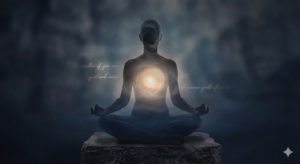
Building on the previous exploration of non-identification with the body, this meditation technique introduces a simultaneous concentration on two non-existent (void) parts of the body, allowing the independent life-energy to stop thought.
Dual Void Focus: Breaking Bodily Identification
The instruction targets the extremities of the body, conceptually dissolving them into emptiness:
Meditate simultaneously, on the above as void and the base as void. The Energy that is independent of the body will make one devoid of thoughts. (Verse 44)
This technique is designed to further break the practitioner’s identification with the body, which the text considers the root cause of misery and bondage.
-
The Above: Refers to the part of the body above the shoulders (the neck upwards).
-
The Base: Refers to the lower part of the body (from the waist down).
Practice Instructions (Simultaneous Dissolution)
This is a seated meditation that uses conceptual negation to achieve an actual state of mindlessness:
-
Posture and Focus: Sit comfortably with eyes closed.
-
Dual Visualization: Focus attention simultaneously on the top (neck upwards) and the base (waist downwards) of the body.
-
Imagine Void/Emptiness: Imagine these two large parts of the body to be void, empty, or non-existent—only space is there.
-
The Witness State: Continue to believe that these parts do not exist. This detachment leads the practitioner into the state of the witness or observer, who watches the body’s activities without being the body itself.
Independent Energy and Freedom from Thought
The promise of this technique lies in the nature of the energy that remains when bodily identification is severed: “The Energy that is independent of the body will make one devoid of thoughts.”
-
Independent Energy: The energy that is independent of the body is the energy of God. The energy that allows the body to exist is still there, but by breaking the identification with the physical form, the meditator taps into the dormant spiritual energy (Kundalini), causing awareness to grow.
-
Devoid of Thoughts: This growing awareness leads to the cessation of thought, which is liberation (moksha). As the mind becomes still, the ego dissolves, and the practitioner becomes blissful, unaffected by external or bodily events.
-
Living without Fear: The commentary connects non-identification with the body to the dissolution of fear, particularly the fear of death, because the True Self (awareness/consciousness) cannot be destroyed. This realization results in a “calm splendor”.
The practice essentially uses the mind to dissolve the mind’s attachment to form, confirming the path to freedom lies in realizing “we are not our body. We are awareness.”