
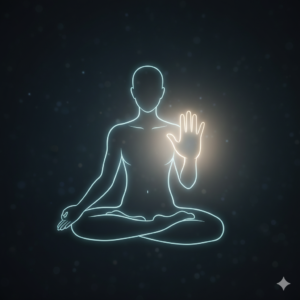
This meditation technique is a simplified and concentrated approach to bodily non-identification, proving that the realization of the body’s non-existence in any one part is sufficient to liberate the entire consciousness.
The Concentrated Void: Splendor of the Thought-Free State
The instruction streamlines the focus on the body’s emptiness:
Free of thoughts, consider for a short while, any part of one’s body as only void. One becomes permanently free of thoughts. Then, one’s own form attains the splendor of the state that is free of thoughts. (Verse 46)
This practice reinforces the lesson that identification with the body is the main cause of suffering and ego. It teaches that because the body is an interconnected unit, the property of any single part applies to the whole.
Practice Instructions (Isolated Negation)
This practice is designed for those who find focusing on the entire body’s emptiness difficult:
-
Posture: Sit comfortably with eyes closed.
-
Choose a Part: Select a small part of the body that the practitioner finds easy to concentrate on, such as the nose, a finger, the chest, or any other part.
-
Conceptual Negation: For a “short while,” continuously imagine and consider that isolated part of the body to be “only void,” empty, or non-existent.
-
The Universal Principle: The core understanding to hold is: “The body is a unit… If a particular part is void, then the entire body is void”.
Freedom from Thought and the Splendor of Form
The result is a total change in the state of being, where the true nature of the self is manifested:
-
Permanent Thought-Freedom: By maintaining this single-point focus on the void, the mind is deprived of its support and falls silent, leading to the state of being “permanently free of thoughts” .
-
The Splendor of the Form: “Then, one’s own form attains the splendor of the state that is free of thoughts.” This refers to the realization of the practitioner’s true nature—pure awareness. When the individual is enlightened, they stop identifying with the body, and the body then radiates a sense of peace, joy, and love, a splendor that enlightened masters like Mahatma Gandhi and Mother Teresa demonstrated.
-
The Witness State: This practice helps the practitioner become a witness, the observer who is aware of all life events without being affected by them, thus transcending all fear and sorrow.
The Vigyan Bhairav Trantra notes that this meditation, like others, can also be practiced as an all-day mental exercise, such as constantly imagining “you have no head” to live in constant, thought-free awareness.